
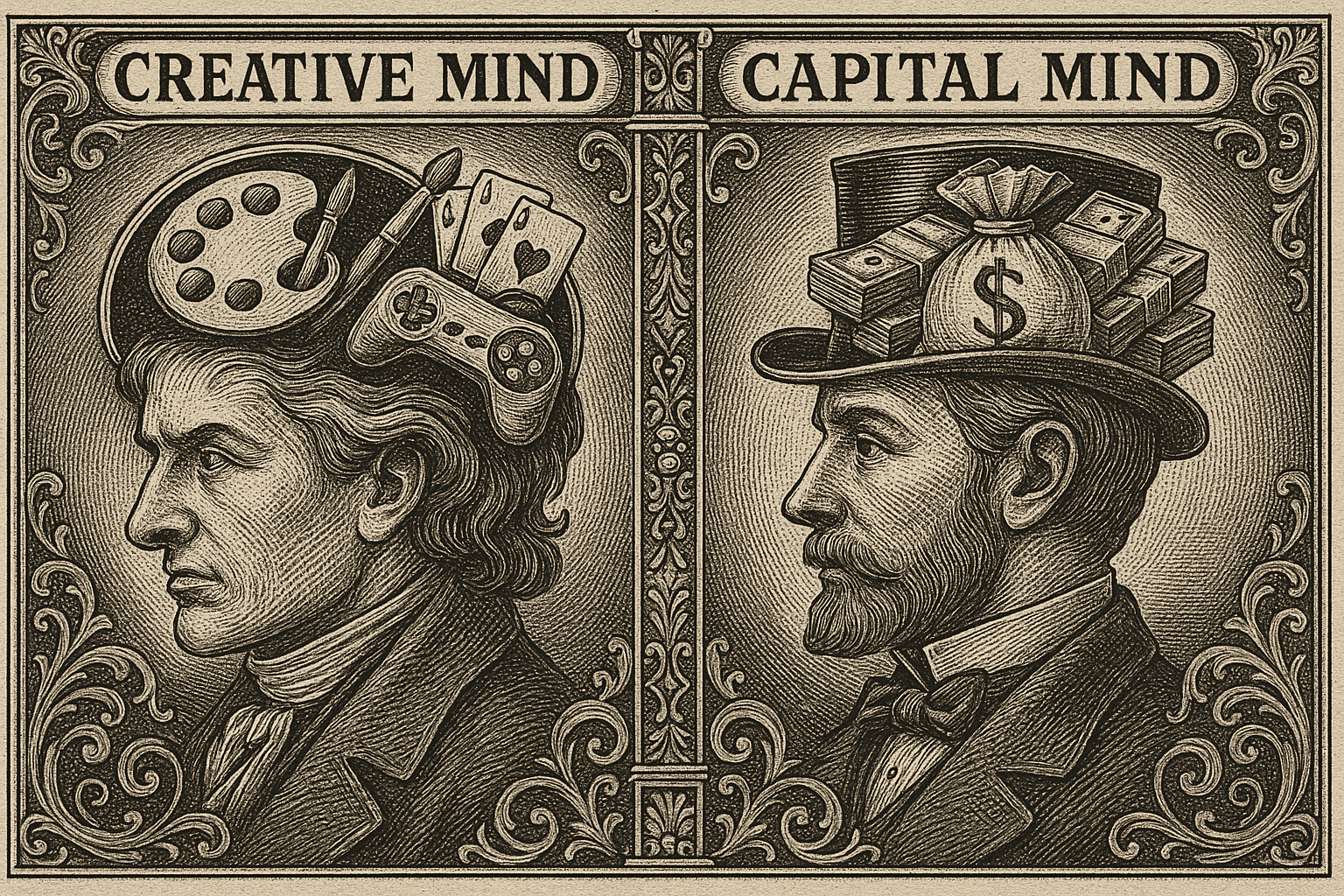
The Creative Mind vs. The Capital Mind

by
Journey
|
Dec 13, 2025
|
0 min read
The Creative Mind vs. The Capital Mind
The market keeps rewarding creativity. The industry keeps ignoring the lesson.
I need to be honest with you about something.
I watched the Game Awards Thursday night and cried.
Not because Clair Obscur: Expedition 33 won nine awards. Not because a small French studio broke records that Sony's The Last of Us Part II set. Not even because half the Game of the Year nominees were indie games.
I cried because I saw what's possible in the midst of what's actually happening.
Sandfall Interactive earned every trophy. Their game is a masterpiece. I'm not taking anything away from them.
But here's the contradiction I couldn't shake: this "indie" team had Kepler Interactive behind them. They had real backing. Real resources. Someone with capital looked at their creative vision and said "yes."
That's beautiful. That's how it should work.
But the same industry that just crowned an indie debut as Game of the Year has spent the last three years laying off 45,000 people. Closing studios. Canceling projects. Eliminating junior roles entirely. One company posted four entry-level positions and received so many applications they had to put a public statement stating they were overwhelmed and would take some time to get through the applicants. The UK's biggest pathway for new developers, Grads in Games, went on hiatus because there's no entry-level hiring anymore.
The market rewards creativity. The industry punishes it.
I've spent the last few days sitting with this. Writing. Rewriting. Trying to make sense of the contradiction.
And I think I finally understand what's happening.
Two Mindsets, Two Different Games
There are two ways to look at any creative project.
The creative mind asks, "Is this good?"
The capital mind asks, "What's this worth?"
Neither is wrong, they're playing different games with different rules. And right now, the game industry is being run almost exclusively by capital minds, even as the market keeps handing trophies to creative ones.
Understanding these two mindsets isn't just philosophical. It's practical. Whether you're a developer trying to navigate your career, an investor trying to spot the next big thing, or a gamer wondering why your favorite studio just got shut down. This framework explains a lot.
The Creative Mind: A Deep Dive
How It Thinks
The creative mind operates on resonance. It asks questions like:
Does this feel right?
Will this moment land?
Is this true to the vision?
Have we made something that matters?
Success, to the creative mind, is measured in impact. Did the player cry at that scene? Did the mechanic click? Did we make something people will remember in ten years?
The creative mind lives in the work itself. It's not that business doesn't matter—it's that business feels like a distraction from the real work. The spreadsheets, the negotiations, the equity splits—that's all stuff that happens around the edges of what actually matters: making something good.
What Makes Them Strong
Vision. Creative minds see possibilities that don't exist yet. They can hold an entire experience in their head and guide a team toward building it. This is the skill that separates a collection of features from a cohesive game.
Taste. They know when something is off, even if they can't always articulate why. This intuition—developed over years of playing, studying, and making games—is what separates good games from great ones.
Resilience through passion. Creative minds will push through brutal production cycles because they believe in what they're making. That intrinsic motivation is worth more than any bonus structure.
Player empathy. The best creative minds are also players. They understand what it feels like to discover a secret, to master a system, to be moved by a story. They design from experience, not just theory.
Where They Struggle
Business blindness. Many creative minds avoid "business stuff" until it's too late. They defer negotiations, stay flexible on compensation, and trust that things will work out. Sometimes it does. Often it doesn't.
Exploitation risk. Because they're driven by the work itself, creative minds can be underpaid, overworked, and undervalued by people who understand leverage better than they do.
Difficulty with scale. The same intuition that makes a creative director brilliant can make them a bottleneck. Not every decision can run through one person's taste.
Negotiating against themselves. Creative minds often undervalue their contributions because the work feels like its own reward. By the time the project succeeds, the percentages were locked in months ago.
What They Need
Systems that track contribution automatically, so they don't have to negotiate their worth before the work proves itself
Collaborators who handle the business without exploiting the creative's blindspots
Fair compensation structures that adjust based on actual contribution, not upfront guesses
Protection from their own tendency to defer financial conversations
The Capital Mind: A Deep Dive
How It Thinks
The capital mind operates on returns. It asks questions like:
What's the ROI on this investment?
How do we de-risk this project?
What's the market size?
Can we scale this?
Success, to the capital mind, is measured in multiples. Did we hit our targets? Did the investment pay off? Can we replicate this success?
The capital mind lives in systems and leverage. It's not that creativity doesn't matter—it's that creativity is one input among many. The real skill is allocating resources, managing risk, and building structures that produce reliable returns.
What Makes Them Strong
Resource allocation. Capital minds understand how to deploy limited resources for maximum impact. They can look at a portfolio of projects and decide where each dollar creates the most value.
Risk management. They think in probabilities and hedge their bets. This discipline prevents catastrophic failures and keeps companies alive through downturns.
Scale thinking. Capital minds see how to take something that works and make it work bigger. They understand systems, processes, and the mechanics of growth.
Long-term planning. They can delay gratification, reinvest returns, and build toward outcomes that are years away. This patience is essential for building lasting companies.
Where They Struggle
Creativity blindness. Capital minds often treat creative talent as interchangeable—a line item to be optimized. They don't always understand that you can't just "hire another designer" and get the same results.
Over-indexing on safety. The same risk aversion that prevents catastrophic failures can also prevent breakthrough successes. Playing it safe is safe—until your competitors aren't.
Metric fixation. Not everything that matters can be measured. Some of the most important elements of a great game (feel, vibe, emotional resonance ) don't readily show up on dashboards.
Short-term pressure. Quarterly earnings, investor expectations, and market pressures can force capital minds into decisions that optimize for now at the expense of later.
What Capital Minds Get Wrong About Games
They won't trust new talent.
It's not about budget size. It's about who gets the opportunity. Capital keeps going back to the same veterans, the same leadership, the same teams they already know. Safe games with familiar names.
Meanwhile there are talented people with fresh ideas who can't get a meeting. Can't get hired. Can't get invested in. Can't get published. All of the above.
The juniors who could bring something new? Not being hired. The small teams with original visions? Not being funded. The pitches that don't look like something that already worked? Not getting greenlit.
Capital minds want predictability. They want to point at a track record and say "see, this person shipped before." But that's how you get the same ideas recycled forever. That's how an industry gets stale while players beg for something new.
Sandfall had no track record. Zero shipped titles. Kepler backed them anyway. Look what happened.
The next breakthrough isn't coming from the veterans playing it safe. It's coming from someone nobody's heard of yet. But they need a chance first.
What Capital Minds Need
Better frameworks for evaluating creative talent, beyond just "shipped titles" and "years of experience"
Patience to let creative visions develop, rather than demanding constant proof of progress
Humility to recognize that creative success isn't fully predictable or controllable
Investment in talent pipelines, because the next Sandfall Interactive is being built right now by people who need a chance
The Disconnect: Why the Industry Ignores What the Market Rewards
The numbers are bad:
45,000 jobs lost in the game industry from 2022 to mid-2025
11% of developers surveyed were laid off in the past year alone
Narrative designers hit hardest at 19%—the people who write the stories that make players care
Entry-level hiring effectively frozen across the industry
AAA budgets ballooning to $200-500 million while teams shrink
And yet: half of this year's Game of the Year nominees were indie games. The winner was a debut title.
The market is screaming: we want creative ambition.
The industry keeps responding: we're cutting creative talent to reduce costs.
How the hell did we get here?
The Post-Pandemic Hangover
During COVID, everyone played games. The industry exploded. Companies hired aggressively, expecting the growth to continue.
It didn't.
When spending normalized, companies found themselves overstaffed and over-committed. The capital mind response was predictable: cut costs. Lay off workers. Cancel risky projects. Double down on proven franchises and genres.
The problem? This response treats the symptom, not the disease. The disease is that capital stopped trusting new talent. They keep going back to the same people, same franchises, same ideas. And then wonder why everything feels stale.
The Junior Talent Crisis
Here's the part that should terrify everyone thinking about the industry's future:
Companies aren't just laying off workers. They're eliminating junior roles entirely.
An analyst quoted in industry reports put it bluntly: "By recruiting only existing senior level talent, there may be no new generation of seniors."
Let that sink in. The industry is so focused on short-term cost savings that it's actively destroying its own future.
The next generation of creative minds—the people who would make the games that define 2030 and 2035—are getting priced out before they ever get started.
What the Market Actually Rewards
Let's be specific about what's winning:
Clair Obscur: Expedition 33 — A debut title from a small French studio. Nine awards at The Game Awards, including Game of the Year. Not a sequel. Not an established franchise. A new vision, executed brilliantly.
Baldur's Gate 3 — Larian took a "dead" genre (massive RPGs) and made one of the most celebrated games of the decade. They ignored conventional wisdom about what players want and trusted their creative vision.
Hollow Knight: Silksong — Years of anticipation built entirely on the strength of the first game. No massive marketing budget. Just a creative team that made something players couldn't stop talking about.
Hades / Hades II — Supergiant keeps making smaller, focused games that consistently outperform expectations. They've built a sustainable studio by trusting their creative instincts.
The pattern:
Clear creative vision beats bloated committees
Focused scope beats feature creep
Passionate small teams beat disengaged large ones
New ideas beat safe sequels (at least at awards time)
Players don't want another safe bet. They want to be surprised. They want to feel something. They want games that take creative risks.
The Bridge: When Capital Believes in Creativity
This is the part that gives me hope.
Clair Obscur didn't happen in a vacuum. Kepler Interactive, a publisher, looked at Sandfall, a studio with no shipped titles, and said: "We believe in this." They funded the vision. They gave the team room to execute.
That's what capital is supposed to do in creative industries. Not just fund sure things. Fund potential. Fund talent. Fund the creative ambition that the market actually rewards.
I think about this constantly.
Somewhere out there is the next Sandfall. A small team with a clear vision and no track record. They're working nights and weekends. They're burning through savings. They're one "yes" away from making something that could win Game of the Year.
And somewhere out there is the investor who could back them. Who could be the Kepler to their Sandfall. Who could look at potential instead of proof and say "I believe in this."
The best investments in creative industries come from backing visionaries before they're proven, not after. By the time everyone agrees something is a safe bet, the opportunity is already gone.
This requires capital minds to do something uncomfortable: trust creative judgment they can't fully measure. Bet on people, not just projects. Accept that some investments will fail so that others can breakthrough.
But when it works? Nine trophies. Game of the Year. History made.
When capital believes in creativity, everybody wins.
What Actually Needs to Change
I'm not naive. I know one blog post isn't going to fix an industry.
But I also know that change starts with people deciding to do things differently. So here's what I think that looks like:
If you're a developer: Stop waiting for permission. Track your contributions now, so you have leverage later. Build portfolios that show your value beyond "shipped titles." Find collaborators who get both mindsets—or start building those skills yourself. And please, don't wait until the project succeeds to figure out what you're owed.
If you're an investor: Develop better frameworks for spotting creative talent. Not just people with resumes—people with vision. Invest in talent pipelines, not just proven commodities. Give creative teams room to breathe. And accept that creative success isn't fully predictable. That's not a bug. That's the whole game.
If you're running a studio: Reopen junior pipelines before it's too late. The next Sandfall is out there right now, sending applications into the void. Stop treating creative talent like line items to optimize. Learn from what the market is rewarding, not what feels safe. Build something sustainable, not another boom-bust cycle.
If you're a gamer: Keep supporting the games that take risks. Keep talking about the indie titles that move you. Your attention and your dollars are votes for what kind of industry you want to exist.
We all have a role to play here.
Why I Built City of Gamers
I need to tell you why this matters to me personally.
I created City of Gamers to be a home.
A home for everyone in this industry, whether they felt like they had a place in it or not. For the developers who got laid off and don't know what's next. For the juniors who can't get their foot in the door. For the creatives who are tired of choosing between making great work and getting paid fairly. For the capital minds who genuinely want to back talent but don't know how to find it.
CoG is their place. Our place.
We started as a scrappy college group in Orlando who just wanted to learn and create together. Didn't matter what your major was or how much you knew, we showed up. We taught each other. We made things. That spirit never left.
But spirit alone doesn't pay rent. Passion alone doesn't fix a broken system.
So we built Royaltea.
Royaltea is the bridge. Not just between creative minds and capital minds. but between all of us trying to figure out how to create together in this new future.
It tracks contributions automatically across the tools teams already use. When the project ships and the market rewards the creative vision, revenue flows to the people who actually made it. No awkward negotiations. No guessing at percentages before the work proves itself. No spreadsheet nightmares.
It's not about turning artists into accountants. It's about building a bridge we can all walk along together.
The creative mind stays creative. The capital mind sees clear, trackable value. And when the game wins Game of the Year, everyone who made it actually benefits.
The Real Opportunity
I'm going to be honest about something else.
I want to be the next Sandfall.
I want City of Gamers to be the next "indie" that a big publisher believes in. I want someone with capital to look at what we're building - Village of the Ages, Royaltea, this whole ecosystem, and say "yes."
I hope we can pull it off. We're working so hard. My team is so passionate about what we're building.
Watching that Game Awards ceremony didn't make us jealous. It made us inspired.
Because here's what we know: the market is begging for creative talent to win.
The studios that figure this out, the ones that invest in creative talent, build pathways for new voices, fund ambition instead of just managing risk - they're going to define the next decade of gaming.
The rest are going to keep laying people off, keep wondering why their "safe" projects underperform, and keep watching small studios walk away with Game of the Year.
The creative mind and the capital mind will always see the world differently. That's not the problem.
The problem is when they stop talking to each other. When capital stops believing in creativity—even as the market keeps proving it should.
We need more bridges. We need more people willing to cross them.
That's what we're building. That's what City of Gamers is for.
Come build with us.
Royaltea is now in beta. If you're looking for a home, whether you're a creator who wants to get paid fairly or an investor who wants to back real talent, we're here.